
Public Forum cut short as ESC Meeting draws a crowd
The Council Chamber was overflowing with residents to hear from the public presenters and a very full Agenda with several contentious matters.
Ironically, when Council was about to hear a Notice of Motion from Cr Mayne about community consultation, the presenters were cut short due to time constraints, given only 4 minutes (from the regular 7) but were only told this a couple of hours before the meeting.
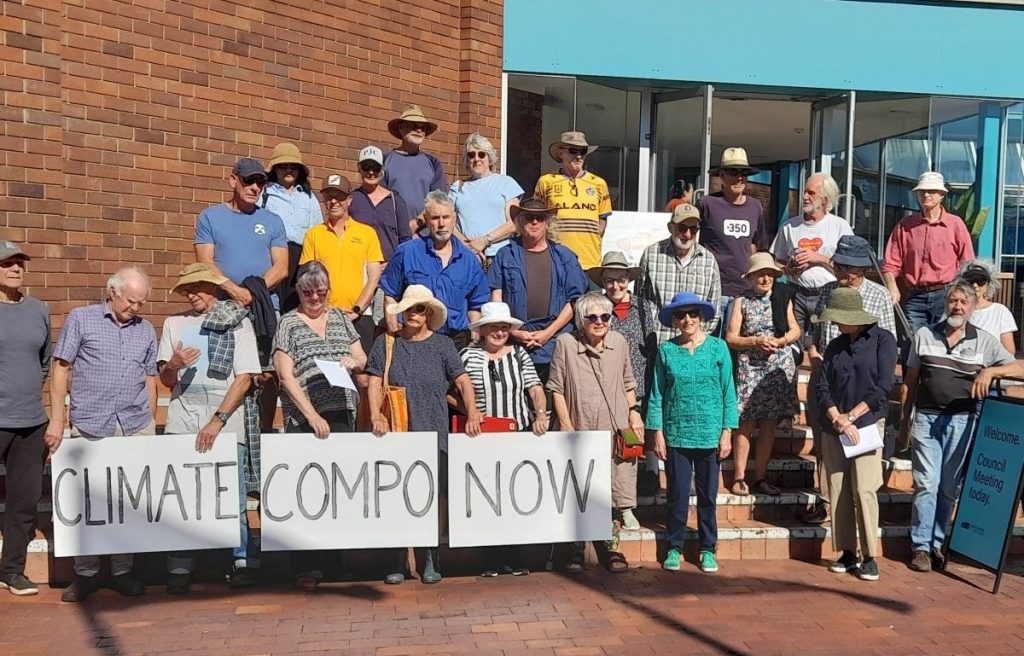
Before the Meeting, around 50 people assembled outside top hear from speakers on the ‘Climate Compensation to Protect Ratepayers’ motion and The Coopers Island Road matter. See pages 5 and 6.
There were three speakers against a 14 Lot Torrens Title Subdivision, public road and earthworks in Annetts Parade, Mossy Point, which used lot size averaging.
Pamela Green addressed Council saying “This is not simply a matter of whether the proposal fits within policy. Under Clause 4.1E (lot averaging), it asks something more. It asks whether you are satisfied that this subdivision will retain environmental values and result in no significant adverse environmental impact.”
She added “The site will still lose around 70% of its native vegetation. It will become fourteen lots – most below the minimum size. It relies on lot averaging. Lot averaging can allow development to step lightly – to gather in one place and leave another intact. But here, the pattern is spread. The pressure is spread. What remains will be irretrievably broken into smaller pieces.
The ecological case rests on retention – trees, corridors, canopy. But there is a difference between what remains, and what continues to function. The impact does not stop at what is cleared, it extends outwards beyond the cleared footprint through light, noise, and disturbance into what remains. This has not been fully accounted for in assessing habitat loss.
For the Yellow-bellied Glider and other vulnerable species, habitat depends on connection. Movement. Return. Continuity. When that breaks, the pattern changes.”
“The decision comes back to two questions –
Are you satisfied that the development proposal in its current form meets the intent of the C4 zone and are you satisfied that environmental values will be retained and that there will be no significant adverse environmental impact as required under Clause 4.1E?
This application asks you to accept that fragmented habitat, small urban lots, and long-term disturbance can coexist with ecological functionality. The evidence does not support that conclusion.
There is still a path through your decision today, where a redesigned development within the intent of the C4 zone, and the land and its life can coexist.”
Council Moved to defer the Matter while more clarification about the C4 zoning (Environmental Living) could be provided.
Several times throughout the meeting, Councillors expressed their frustration at being unable to fully understand some of the information before them.
This has been brought about by the NSW government change in the standard Code of Meeting Practice that no longer allows closed Councillor workshops with staff. While the intention of the State was to improve transparency, it leaves Councillors, especially new councillors, at a disadvantage as they cannot ask questions and get advice about varying matters, especially planning legislation.
Council Agendas are only available seven days before the meetings and are often hundreds of pages long. Councillors have little time to digest often complex matters.
Last year LGNSW President Cr Phyllis Miller OAM said
“While acknowledging the new code, LGNSW remained disappointed with the Minister’s decision to prohibit briefing sessions for elected council representatives.
“Councillors are elected to make informed decisions on behalf of their communities,” Cr Miller said. “Briefing sessions are not decision-making forums – they simply ensure councillors are properly equipped with the background and technical information they need before a matter comes to the public chamber.
“These briefings lead to better informed representatives and, ultimately, better decision-making outcomes for communities, but decisions are – and always will be – made transparently in council meetings, in full view of the public.”
Cr Miller said LGNSW would continue to listen to councils, capture their feedback on the code’s operation, and share this with the Minister and OLG.”
Other matters discussed were:
- Council Processes for receiving and considering community submissions
- The Rezoning of Land for Residential Purposes Reservoir Road, Malua Bay.
- The Moruya Flood Study and Flood Risk Management Study and Plan
- Exhibition of the 2026-2027 Draft Operational Plan, draft Fees and Charges 2026-27 and 2026-36 Long-Term Financial Plan
The five items deferred were:
- FCS26/010 Part Road Closure – Within Lot 4 DP 37552 Mymossa Road, Wamban
- FCS26/011 Audit Risk and Improvement Committee – Meeting Minutes 3 December 2025
- FCS26/012 Investments made as at 31 March 2026
- IR26/004 Post Exhibition Review – Draft Review of Environmental Factors for the Maloneys Beach Reserve Access Upgrade Project
- IR26/006 Local Transport Forum No.7 for 2025-26
All the public presentations from the day will be on the Council website.